One chord, four tunings
G, as Sitka ranks it first in each
Not transposed and not a capo trick. The fretboard is a different instrument under each tuning, so the search runs again from scratch — and the same six strings go from needing three fingers to needing none. The notes underneath each diagram change too: in DADGAD the low D stays put and G arrives as an inversion.
x-0-0-0-0-0
Strum it. No hand on the neck at all.
0-2-0-0-2-0
Two fingers, and the drone stays in the bass.
3-2-0-0-0-3
The shape everyone learns first.
5-2-0-0-0-3
The same notes, but a stretch to the fifth fret.
Zero shapes in common. Four different instruments.
Inside the app
A tuner, a songbook, a vocal trainer and a metronome
Four tabs, and they know about each other — the tuning you pick in one is the tuning the others work in.
-
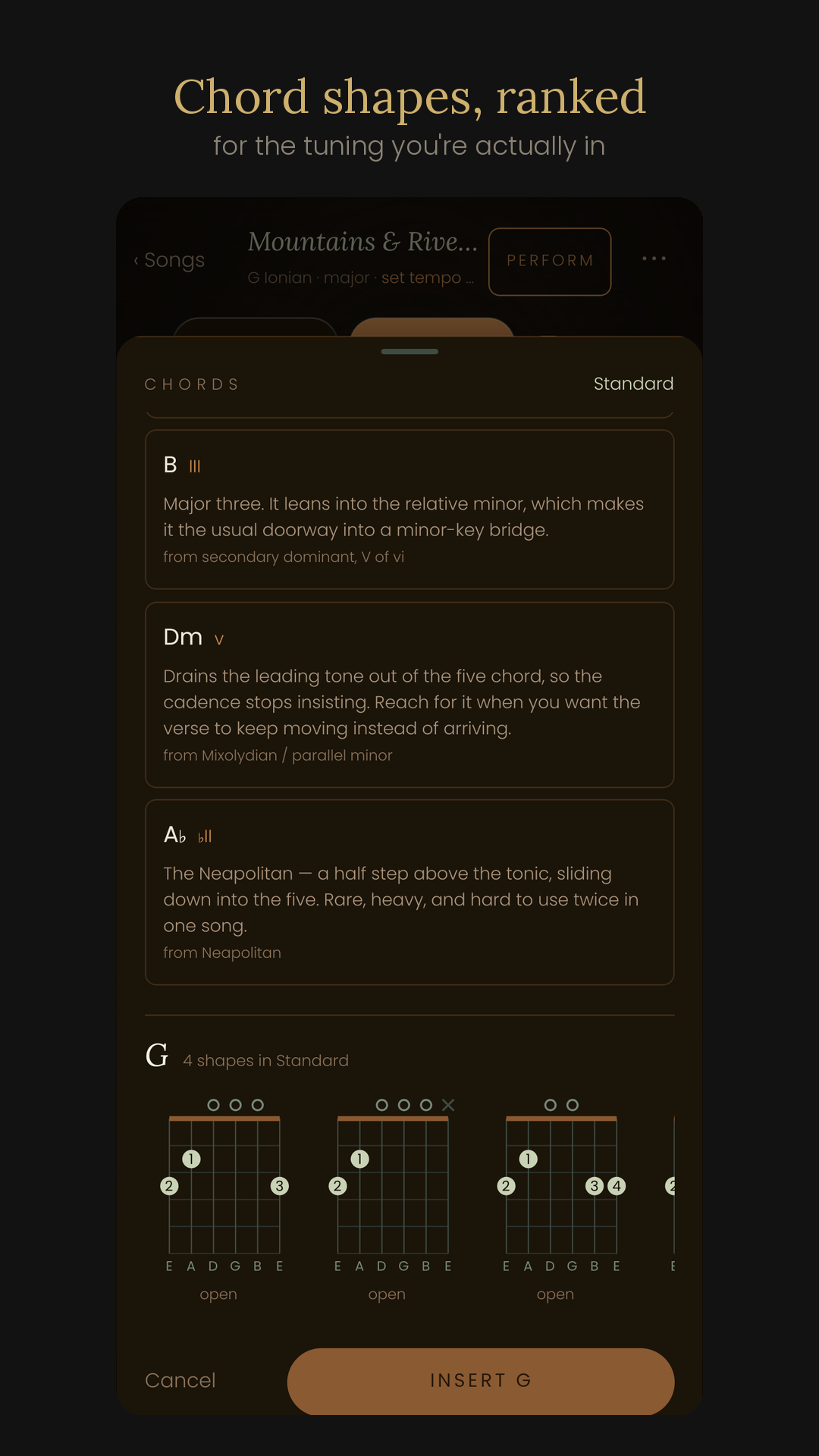
The chord picker inside the song editor. Every chord in your key with a line on what it does to a progression, and the playable fingerings underneath, best first. Tap one to drop it into the line you are writing.
-
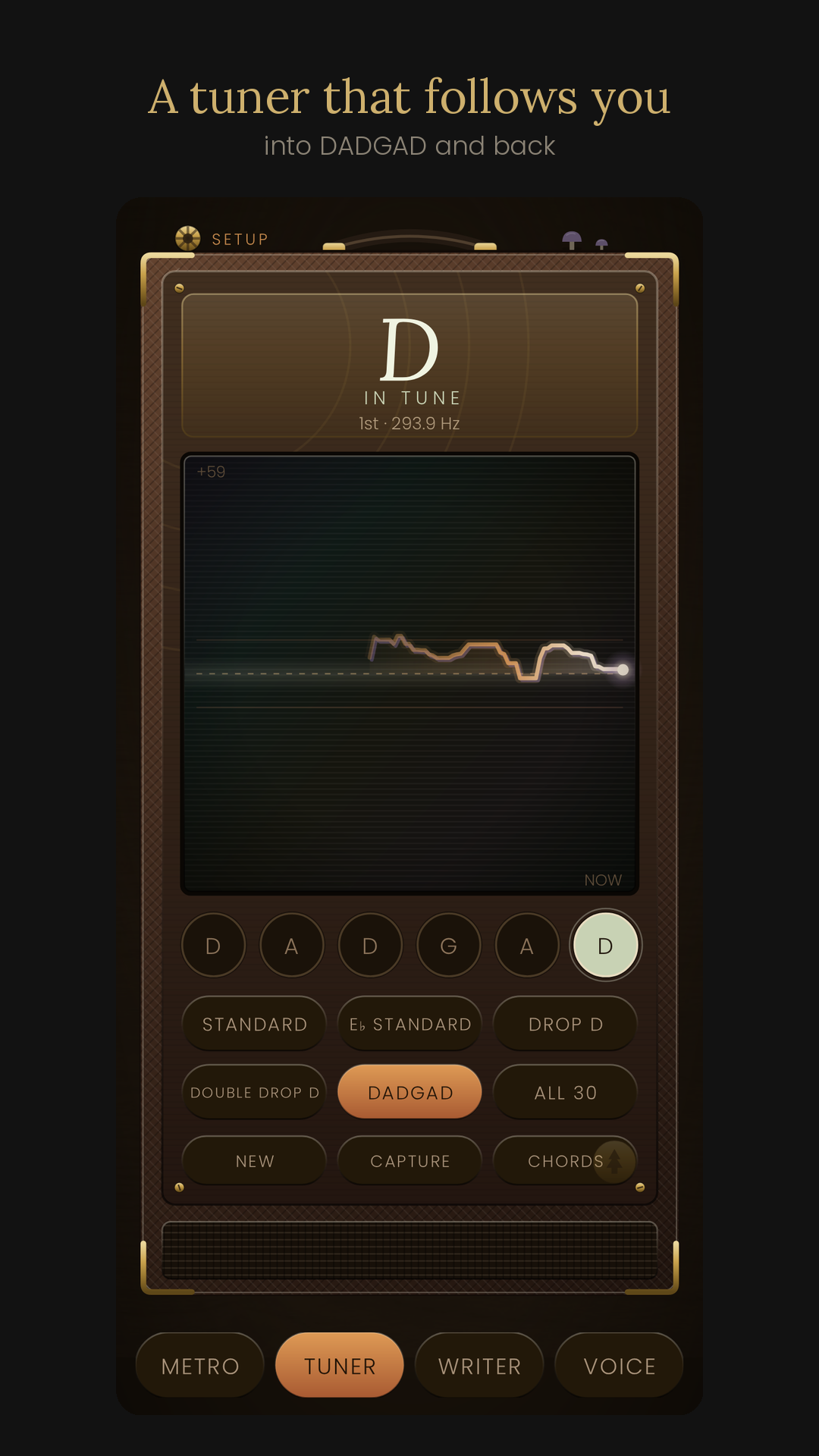
The tuner reading the first string, mid-pluck. The trace is the last few seconds of pitch, so you watch a string settle rather than guess. Pick a different tuning from the row below and the readout, the string buttons and the chord shapes all change with it.
-
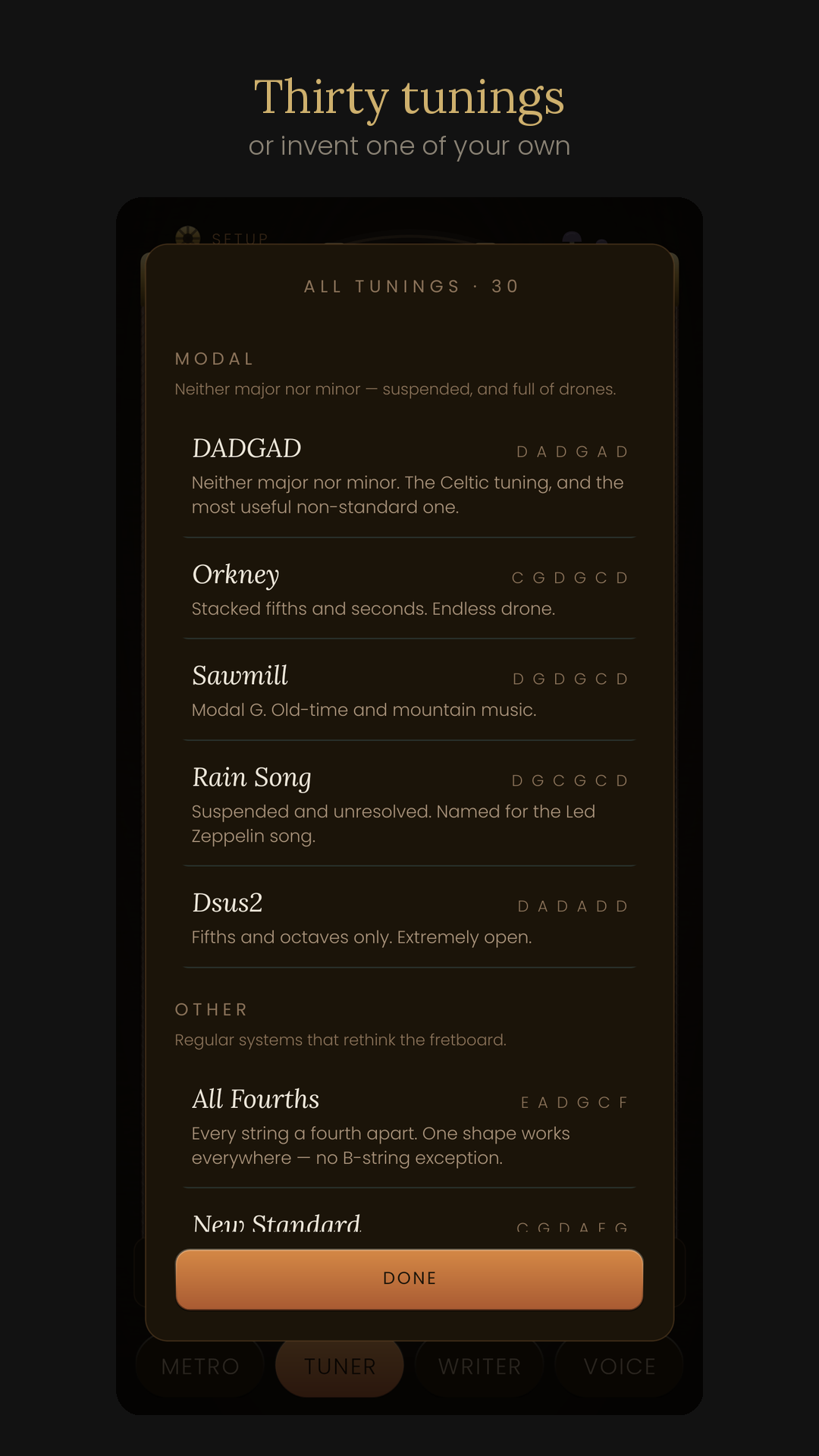
The full library, grouped by family. Each tuning carries a line on why you would reach for it — Orkney is stacked fifths and endless drone, All Fourths drops the B-string exception — so it reads as a menu rather than a list of names.
-
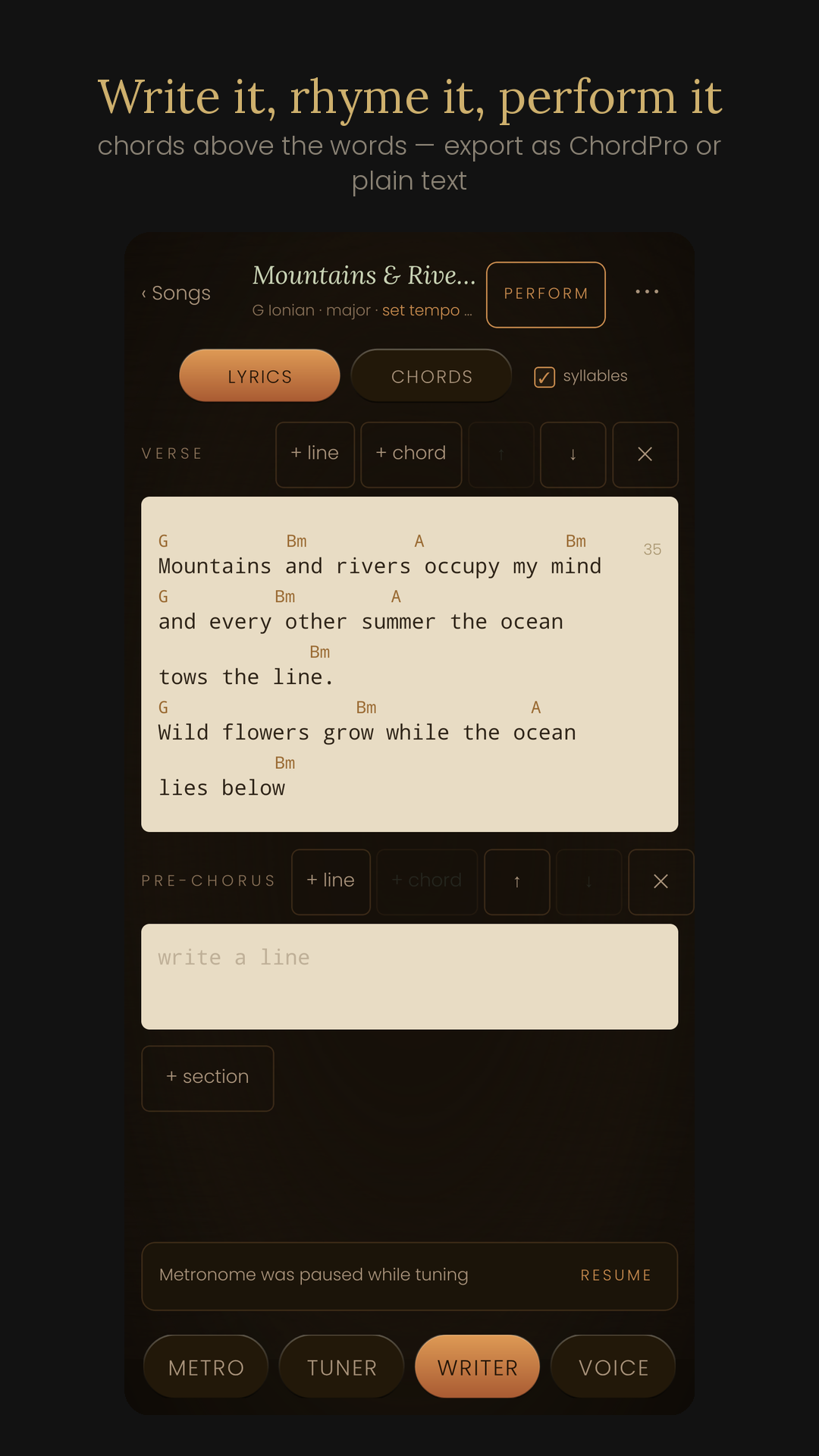
Words with the chords sitting above them where you put them, a syllable count on every line, and sections you can add and reorder. It is not a private file format: export as ChordPro or plain text whenever you like.
-
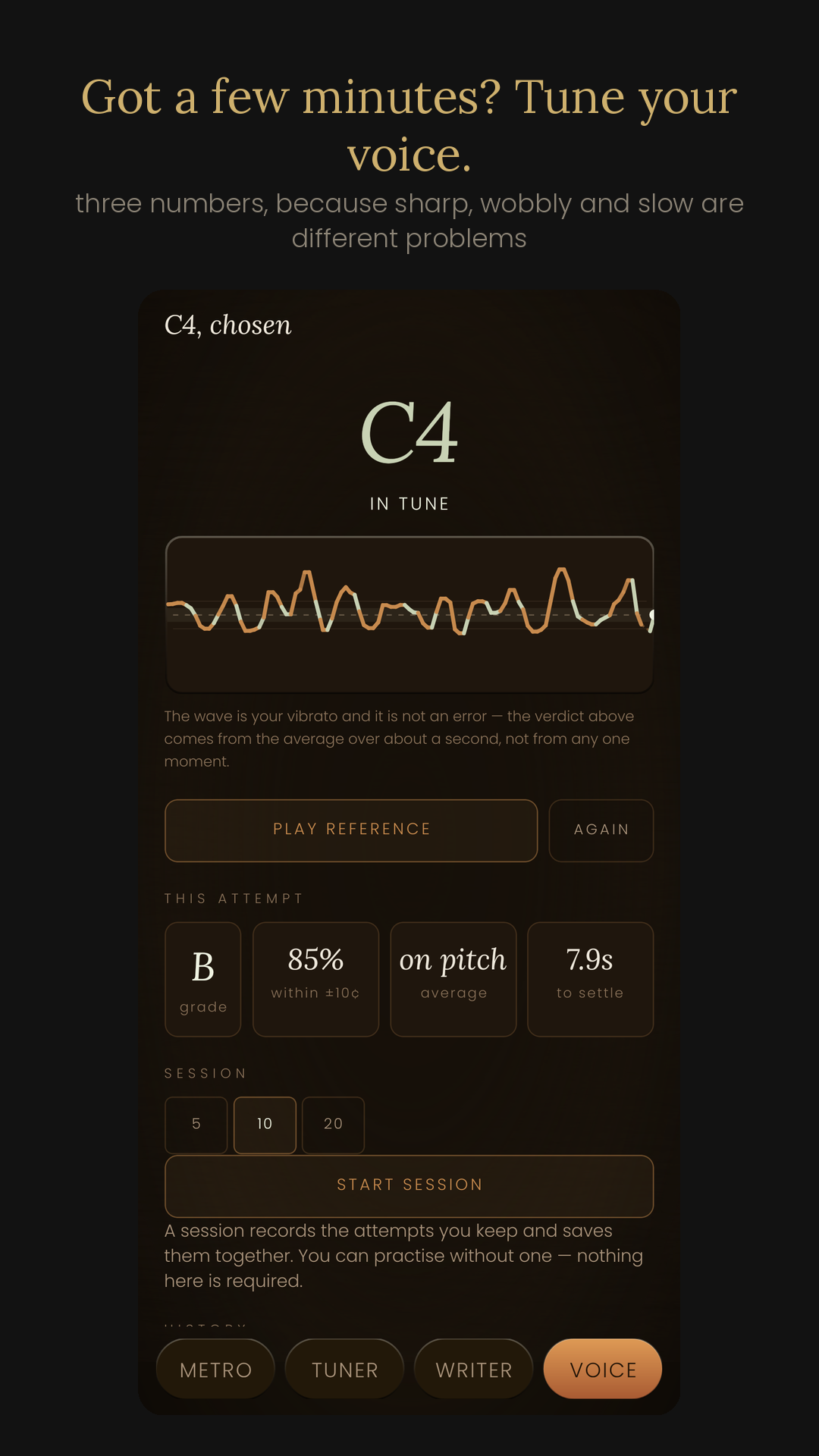
Sing a note and it measures three things separately — how much of the time you were in tune, whether you sat sharp or flat, and how long you took to find the note. The wave is vibrato rather than error, which is why the verdict comes from a one-second average.
-
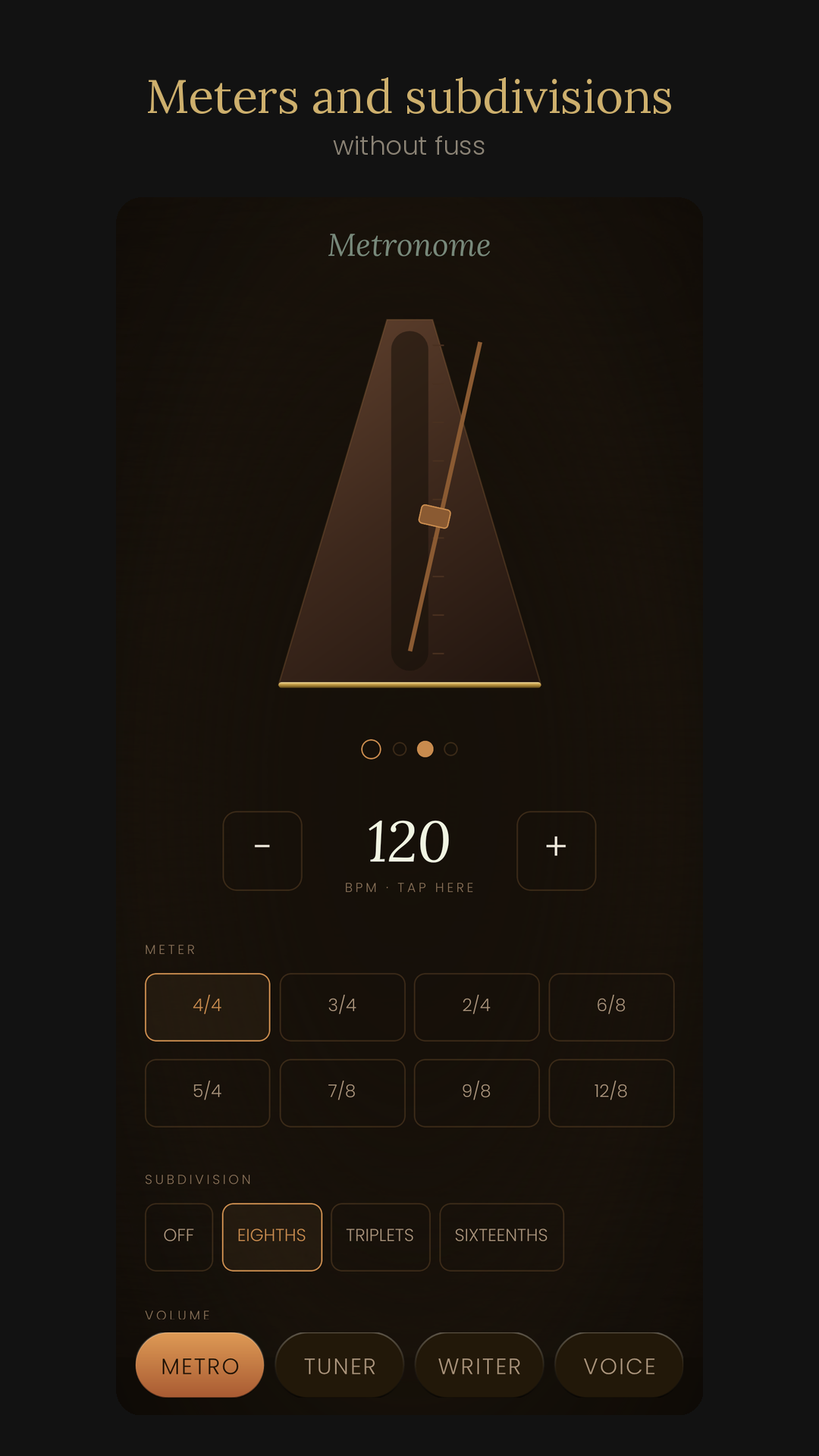
Eight time signatures, four ways to divide the beat, and tap-to-set tempo. The pendulum swings in time, and it stops itself when the tuner or the vocal trainer needs the microphone.
Chord voicings
Shapes for the tuning you are actually in
Sitka generates chord shapes for whatever tuning is selected, ranks them by how playable they are, and puts the ones worth learning first. It searches the fretboard rather than looking anything up, so there is no such thing as a tuning it has no chart for.
Invent one a semitone at a time and that works too — the tuner and the chord shapes both follow you into it.
- Standard
- Drop D
- DADGAD
- Open G
- Open D
- Open C
- Modal
- Slack key
- 30 in all
What "ranked" means
Three ways to play G. They are not equal.
Every chart gives you a shape. Sitka gives you the ones worth learning first, and says why: open strings ring longer than stopped ones, the root in the bass sounds like the chord you asked for, and fewer fingers means you can change to it in time.
3-2-0-0-0-3
58 score
G B D G B G
3-2-0-0-0-x
55 score
G B D G B ·
3-2-0-0-3-3
53 score
G B D G D G
Five points between first and third — one open string, and one finger.
The tuner
Built to be right, not to look busy
Pitch detection on the YIN algorithm, verified against reference tones. It reads a low E as a low E instead of flipping an octave, stays quiet between plucks in a noisy room, and reads the sample rate from your phone's hardware rather than assuming it — the shortcut that leaves some tuners consistently sharp on some phones.
Play the guitar and it will capture the tuning you have already found by ear, string by string.
The library
Thirty, and they come in families
Thirty is a number. This is the shape of it — and why the open tunings are the biggest group, because that is where most of the interesting ones live.
Standard & shifts
Standard, E♭, D, C
Dropped
Drop D, Double Drop D, Drop C, C♯, B, A
Open
D, Dm, E, Em, G, Gm, A, Am, C, Cm, C6, F, B
Modal
DADGAD, Orkney, Sawmill, Rain Song, Dsus2
Other
All Fourths, New Standard
And a custom one, a semitone at a time, if none of them is yours.
Songwriting
Somewhere to put the song
A writing side that knows what key you are in: diatonic chords with roman numerals, borrowed chords when you want the surprise, and a rhyme dictionary that ranks by sound rather than spelling. Chords sit above the words, where you put them.
Export as ChordPro or plain text, whenever you like.
Also inside
A metronome, and a trainer for your ear
A metronome with meters and subdivisions. And a vocal trainer that reports three numbers rather than one — how long you held the note, whether you sat sharp or flat, and how long you took to find it — because those are three different problems with three different fixes.
It builds every exercise inside the range you gave it and never above it.
Privacy
It stays on your phone
This is not a promise about our intentions. It is a property of how the app is built.
- No account, and nothing to sign up for.
- No analytics, no ads, no tracking of any kind.
- The only thing Sitka connects to is Google Play, to verify an in-app purchase. There is no server of ours for it to reach, because we do not run one.
- The microphone is used to measure pitch. Audio is analysed as it arrives and discarded; nothing is recorded and nothing is stored.
- Your songs, tunings and practice history are saved only on your device, never transmitted, and not copied into any cloud backup.
The full privacy policy is short, and says the same thing at greater length.
Free — tuner, all thirty tunings, metronome and songwriting. No subscription, no ads, no account.